
Code of conduct
Taekwondo’s founder General Choi Hong Hi laid down the following philosophical principles, which became the basis of Taekwondo philosophy and by which all diligent students of this martial art must live:
- Be willing to go, even though the journey is hard, and do what needs to be done, even if it is not easy;
- Be attentive to the weaker and strict with the stronger;
- Be content with the money and position you have. Never be content with your own mastery;
- Always finish what you have started, be it big or small;
- Be ready to learn from every person, regardless of faith, race and ideology;
- Never yield to pressure or threats when doing something for a noble cause;
- Learn worldviews and acquire skill through deeds, not through words;
- Remain true to yourself even when the circumstances of life change;
- Always be a teacher who teaches with the body when young, with words when old, and with spiritual legacy after death.
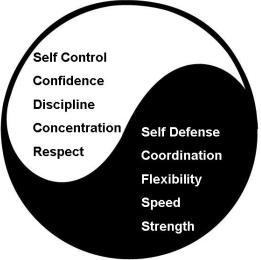
In ancient times the study of martial arts and Buddhism were often connected and took place in the same premises. For this reason the training hall has a special meaning. Understanding that the hall is the place where a student develops spiritual and physical perfection allows us to grasp the deep meaning of etiquette and helps us to remember and follow all of its rules:
- Enter the hall slowly, with dignity, without talking and without making noise. On entering, stop, look straight ahead, try to see the whole hall and sense its atmosphere. Then perform the traditional bow. When leaving the hall, bow in the same way;
- A bow must also be performed: when addressing the instructor and when the instructor addresses you; when receiving any instructions and advice, except for remarks made in the course of an exercise; when approaching the instructor and when moving away from them;
- Before addressing the instructor, check your appearance and formulate the question or request clearly. When standing in line, wait for the exercise to finish, then raise your hand, receive permission and address the instructor in the established manner;
- When speaking to the instructor, it is customary to use a special form of address that corresponds to the instructor’s level of mastery. Do not interrupt the instructor, do not be impatient or irritated, do not turn away, make unnecessary movements or raise your voice;
- When several people perform a bow, one of them (usually the eldest or the one standing on the right) gives the prescribed command. In that case the traditional greeting “taekwon” is said at the same time as the bow. If an international instructor with a higher level of mastery (not lower than a black belt) enters the hall, the command to bow is given by whoever is nearest the door;
- Before the training begins, independent warm-up, stretching and technical exercises are allowed. Discussions on questions of technique, tactics and training methods are permitted. One must speak quietly, except when addressing the instructor. When preparing for training, do not disturb other students with your greetings, questions and conversations while they are busy;
- In the group line-up the group leader or the senior student stands on the right in the first row, followed by the other students according to their level of mastery. Students who do not have the required uniform or who are late stand at the back. If you are late, approach the instructor and get permission to join the line;
- In all formations, alignment is taken from the person in front and the person on the right, and all places in the line must be filled. Alignment is checked at every change of formation and at the start of every exercise. This develops a sense of distance and reduces the risk of injury;
- At the ritual at the beginning and end of the training, on the corresponding command all trainees turn to face the instructor, and at the end of the training also towards the group leader, and perform the prescribed bow;
- During training you must be focused and attentive, know your place and be able to take it quickly; all movements are done at a run. Do not leave the line or the training hall without permission. Listen carefully to all the instructor’s explanations and look straight at the instructor. Ask questions properly and only after all the explanations. Perform all exercises according to the task and do not stop an exercise without the corresponding command;
- Throughout the training you must control your posture, facial expression and body language. Control your emotions both when an exercise succeeds and when it fails, and bear fatigue and pain with dignity;
- During breaks that occur in the course of the training, do not leave your place, sit, lie down or talk. Independent recovery of breathing, stretching exercises or repetition of technical elements is allowed;
- During training any conversation between trainees is forbidden, except when it is necessary to coordinate joint action in pair or group exercises. In that case one must speak quietly and only about the matter at hand;
- When working with a partner, be careful and correct, and avoid causing injury. Point out noticed shortcomings without offending the partner’s dignity, and do not demand that a mistake be corrected immediately if that is clearly not feasible. In case of disagreement avoid arguing and turn to the instructor or the instructor’s assistant for clarification;
- When standing in line, do not turn your back to the instructor unless it is connected with an exercise. If you need to adjust your uniform, protective gear, hair and so on, turn to the left or right. This may be done only during pauses or with the instructor’s permission;
- Staying in the hall in outdoor shoes and/or with headwear is forbidden. It is forbidden to eat, drink, smoke, chew gum, make a noise, disturb others, talk loudly or laugh.